When Ted first mentioned the Internet of Things, for some reason my mind went to the future. It was only after further contemplation that I realised that the Internet of Things is now. I tried to think if I might be interacting with some of these objects on a day to day basis and how this affected my life. In the video below I demonstrate an object in my life that is connected to the Internet of things (please don’t judge!)
While tracking your health and fitness could seem like an exciting concept, it’s important to think about who else can see this data. In terms of Fitbit the company often sells information to third parties with the subject’s name removed. Furthermore, this type of data has already been used in court, with one woman using Fitbit collected data in an injury claim.
Data from the body could be considered some of the most personal information, so it’s certainly problematic that Fitbit is using it to make a profit. This also leads to the question of what else this information could be used for. Is the Internet of Things a road to further convenience or a decline in privacy?
This week’s lecture had me thinking, “Freedom to the people! Down with the institutions!” Ted spoke about Internet hackers and their ability to release important and hidden information to the general public. It seemed that these hackers were kind of like the Robin Hoods of the online world, except instead of taking wealth they were giving back the truth.
However, I’m inclined to be a tad cynical when it comes to this type of utopian thinking and so I wondered if the hackers had any responsibilities in sharing information. My mind went straight to the case of Edward Snowden.
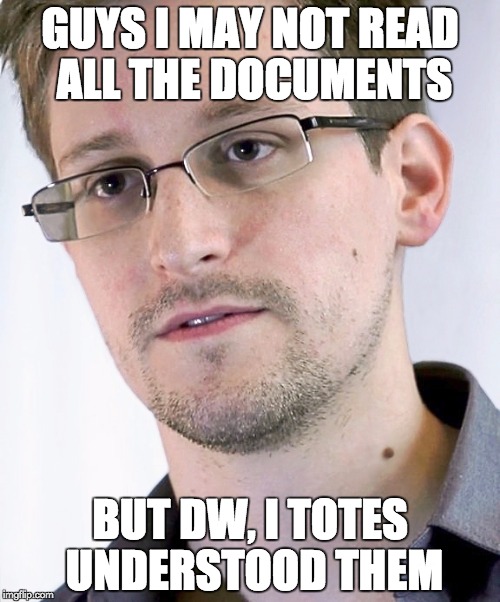
Edward Snowden is a former NSA employee who leaked numerous classified documents detailing global surveillance programs in the U.S. If you don’t know much about this I suggest you watch this John Oliver clip (I know its long but its so worth it!)
What was interesting was that despite stealing the documents, Snowden didn’t want to take the responsibility of releasing them, stating in an interview on the documentary Citizenfour that, “Honestly I don’t want to be the person making the decisions on what should be public and what shouldn’t, which is why, rather than publishing these on my own or putting them out openly, I’m running them through journalists.”
This seems like a responsible action until you consider the consequences of giving a third party the power of censoring sensitive information. In fact, the New York Times actually failed to redact information that revealed that the U.S. was monitoring Al Qaeda in Mosul. In his interview John Oliver refers to this as “a fuckup” and tells Snowden he has to take responsibility for that mistake. Further, upon being asked if he’d read all of the documents Snowden replies that he understands them. Oliver points out that this is not the same as reading the documents, which again brings attention to the responsibility of hackers. Is it responsible for hackers to take the stance of Julian Assange and “let people fight with the truth”? Should they have to read all the documents they release and select the ones that are safe or should they release everything in the name of the truth?
Today I’m discussing how the social media revolutions such as #arabspring and #mena relate to my digital artefact! Let me know your thoughts and how social media has played a role in your digital artefact! Don’t forget to follow More Than The C-Word!
After lots of technical difficulties I’m finally able to present my first ever soundcloud! In this recording I talk about the relevance of the Cathedral and Bazaar development styles to my digital artefact. You can check out More Than The C Word here and let me know your thoughts down below. Alternatively you can tweet us @morethanthecwrd.
I’ve discovered a lot of benefits of the bazaar style but I’m wondering if any of you have found downsides in your development of your digital artefacts. If you’re using the cathedral style instead I’d be interested in learning the benefits and limitations as I haven’t been experiencing it myself!
Finally my video about the walled garden is ready! This time I wanted to talk more about my digital artefact and how this theory applies to it. If you want to check out the website you can find it here! Otherwise feel free to follow us on Twitter (@morethanthecwrd) and Instagram (@morethanthecword).
Unless you were born in 2013 you’ve either watched or at least heard about the above video. In 2012 the American NGO Invisible Children produced a 30 minute movie calling everyone to “make Kony famous” in the hopes to eventually find and arrest him. Initially 20 celebrities including Angelina Jolie, Justin Bieber and Ellen Degeneres were recruited to use their voices in order to spread awareness of the initiative, and due to it’s widespread success many more joined the cause. The video spread motivation and inspiration; finally it seemed we could do something about the horrors of the world.
One share on Facebook and all was right with the world… except it wasn’t. What the video and cause failed to do was actually portray the complexity of the issue in Uganda, and even misrepresented facts on the issue. Not only this but it perpetuated this Western idea that awareness is what will ultimately solve the world’s problems. Jimenez (2013) writes:
“The tragedy behind these sorts of campaigns is that they are motivated by the belief that problems around the world remain unresolved due to the lack of international awareness of their existence or global commitment to resolve them. If only enough people knew and cared about a certain conflict or problem, the assumption goes, then the combined energy and support could be harnessed in order to trigger an immediate flood of solutions. “
This mindset, however is highly problematic. While awareness is important for raising funds, more complex solutions are essential in providing aid to developing countries.
The issue with a celebrity putting their name on a cause is that the reputation of said cause could rely on that of the celebrity. If the celebrity loses credibility or respect from the public, so too could their charity or cause. The founder of Invisible Children, Jason Russell, rose to celebrity status after the success of the Kony 2012 video. However after suffering from a psychotic breakdown and the resulting events of the below video (apologies for the source), many lost faith in the Kony cause. Russell was quoted saying:
“The thing that sucks the most is that it gives people an excuse not to do anything.
“People are like, ‘Didn’t that filmmaker take all the money and then go crazy naked in the street?’”
So while I’m not questioning the good intentions of celebrity activism, there certainly are some implications. It’s important to mention that Kony still hasn’t been captured, three years on, and there are still existing problems in Uganda. While celebrity-spread awareness may placate our “white saviour complex” for a couple of weeks, it may not be the most effective solution in providing aid.
Above is my first ever info graphic (*pats self on back*)! I wanted to outline Kelly’s (2008) 8 Generatives that are better than free. I found his approach to the issue of the long tail really interesting and thought it would be a good idea to break it down. In a world full of free information and content, it is imperative to understand what is valuable in order to sell a product. Kelly has accumulated a great list of product attributes that are better than free, but I’m curious to know if this list could be added to. Are there other generatives that can’t be copied that aren’t on Kelly’s list?
Yes, yes I know what you’re thinking: “Another meme, how original…” When thinking about this week’s topic of liquid labour what really resonated with me was this idea of how work and personal life have begun to combine. With thanks to advancements of communication networks like the web, there is a constant supply of information workers on hand for any given job. Due to this, along with the continual accessibility of information, there is almost an expectation of workers to be available for work. The sheer speed of information flows has workers feeling that they need to keep on top of their work 24/7.
The rise of communication networks also has begun to make the concept of traditional office spaces somewhat irrelevant. In traditional work, just like the factory, the office almost stands as a symbol for the work space. Once a worker leaves said work space, they are no longer at work. This, however, is becoming less and less true with many workers taking their work home with them via the web. With the majority of information work not being in a physical space, but on the web, is there a necessity for a specific physical space designed to carry out this work? Why should workers feel motivated to wake up early to travel to an office when they would be perfectly fine doing the same work at home in their pyjamas?
Which brings me to my meme this week. Has Dolly Parton’s 80s hit 9 to 5 also become irrelevant?